The field note starts where the public record can embarrass the build.
I do not trust a proof journal because it can summarize a build day. Summaries are cheap. I trust it when the article names the pressure, pulls from the operating system, shows what proof exists, keeps private material behind the right wall, and still sounds like a founder made a decision in public.
The compact Bookwright test
The article has to be the first proof object.
A receipt can prove bytes. It cannot make weak thinking strong. The article itself has to be worth signing: a real thesis, a real visual lane, a reader map, proof language, boundary language, and enough teaching value that a developer or buyer can use it without a private explanation. That is the floor.
weak_field_note = topic + summary + receipt_words
founder_field_note = wound + machine_memory + proof_boundary + operator_move

A field note should feel like the operating room made readable: pressure, system memory, public proof, and enough visual voltage to make the thought stick. The page has to feel operated. ⚡
A technical blog does not rot because the sentences are bad. It rots because the sentences stop remembering the system that made them necessary.
Why does a technical blog fail when it cannot remember the system?
The easy failure is ugly writing. Everybody can see that. The more expensive failure is clean writing that floats above the product like it was written from another room. That is the kind of AI slop that scares me most: smooth enough to pass a skim, empty enough to make the company look smaller than the work.
DevodeRator cannot work that way. This site sits beside the 0S, SkyeMail, SkyePay, SkyeVault, SkyeNet, Citadel Database, Darthom Intelligence, and the actual proof receipts that keep the company honest. A public article here has to carry memory. It has to know what lane it is talking about, what proof exists, what boundary protects the buyer, and why a serious reader would care.
That is the first standard: memory before melody. I do not care how pretty the paragraph is if it forgets the operating pressure. The post has to open with a real problem, build the gap, answer with targeted 0S intelligence, show the proof path, name the boundary, and leave the reader with a move.
- Problem: public writing gets cheap when it explains the surface without remembering the machine.
- Proof: DevodeRator has to point toward receipts, live links, route behavior, product pages, and source-safe context.
- Boundary: private implementation source, secrets, restricted attribution, and prompt mechanics stay out of the public page.
The archive has to feel like a person who was actually in the build.
The founder voice matters because the 0S was not born from a clean spreadsheet. It came from pressure: broken routes, payment gaps, mailbox parity fights, source-custody fear, AI lane arguments, proof receipts, customer paths, and the very human irritation of watching a serious system get described like a generic SaaS toy. A DevodeRator article has to keep that pulse.
That does not mean the page gets to become careless. Color can sharpen a point. A well-earned curse word can call out a fake dashboard faster than three polite paragraphs. But the heat has to aim at the failure mode: dead buttons, fake telemetry, vague AI, broken checkout, source leakage, untested claims, and sloppy customer paths. The heat does not belong on protected identity, disability, race, gender, sexuality, or any human category. Precision is the difference between voice and mess.
The best public writing in this ecosystem sounds alive because it has consequences under it. The reader can feel the route, the receipt, the buyer, the operator, the risk, and the reason. That is why I want emojis in the flow without turning the article into a sticker sheet. A little ⚡ in the right sentence can keep the page breathing. A neon word in the right spot can tell the reader where the thought is burning.
Darthom Intelligence is the difference between content and context.
Darthom Intelligence matters because the company already has a public knowledge surface with real technical gravity. The article should not act like it woke up with no memory. It can read the public brain context, use the 0S vocabulary correctly, understand the proof culture, and connect the specific build lane to the larger operating system.
The public reader does not need the entire brain dumped on the page. That would be lazy in a different costume. The point is synthesis. The page should feel like it was written by someone who knows the system, not by a content mill that swapped in product names. When SkyeMail appears, the writing understands identity, inbox flow, CRM, calendar, docs, and SkyePay. When SkyeVault appears, it understands source custody, restore posture, runtime packaging, and owner boundaries. When SkyePay appears, it understands pricing truth and entitlement consequence.
That is why the blog publishing lane has to be held to a hard standard. It cannot be allowed to publish a polite nothing. It has to use memory, proof, and taste. It has to know when a sentence is public-worthy and when it is just internal scaffolding trying to sneak onto the page.
The agent has to behave like an operator who understands why the noun matters. If the post says SkyeMail, it should not sound like a newsletter app. It should understand mailbox identity, inbound truth, provider boundaries, workspace movement, 0S entry paths, AI review, and customer trust. If it says SkyePay, it should not sound like a buy button. It should understand offer shape, entitlement, proof links, pricing memory, checkout risk, and fulfillment. If it says SkyeVault, it should understand custody, restore, source separation, and why a public proof sentence can never become a secret leak.
That is the standard that keeps the writing expensive. Not long for the sake of long. Not a fake academic costume. Expensive because the thinking has to know the system. Expensive because the page has to make a reader smarter than they were before they clicked. Expensive because the founder voice is not decoration; it is judgment under pressure.
The proof cannot be buried under the vibe.
DevodeRator can look wild. It can use Pixel Game headings, dev-style body type, founder media, neon links, and a little operating-room theatre. I like that. The site should have a face. But the visual system only works because the proof is sober underneath it. If the page looks alive while the links do not click, the design becomes a liar.
So the public archive needs boring discipline inside the loud room. Homepage cards have to open the full posts. Sitemap and search have to know the route. Feature images have to render without cutting off the founder. Posts need proof language, boundary language, first-person voice, real source links where the argument needs outside weight, and enough structure that a mobile reader can keep up.
This is where AI-assisted writing either becomes useful or gets thrown out. The useful version does not publish because it generated text. It publishes because it survived the same evidence path a human editor would respect: source context, live proof, link truth, visual fit, leak audit, and production deploy.
That is also why the proof cannot live only at the bottom of the page. A serious reader should feel the inspection path early: what is the claim, what public surface can they open, what receipt shape supports the claim, what stays private, and what move should they make next? If that route is hidden, the article starts acting like normal marketing, and normal marketing is exactly the weakness this archive is supposed to outgrow.
The writing can still be beautiful. It should be. But the beauty has to carry structure. The paragraph can swing, the heading can glow, the image can feel cinematic, and the emoji can land like a wink in the middle of a sharp sentence. Under all of that, the page has to behave like a system artifact: readable, linkable, inspectable, source-safe, and impossible to confuse with filler.
This is where the article becomes a useful piece of the 0S instead of a decoration beside it. A reader should be able to enter from a homepage card, land on the proof route, skim the chapter cards, jump into the source trail, test the claim against the boundary, and leave with a mental model they can use. That is a product experience. It just happens to be made of writing.
The page also has to respect attention. Not every paragraph needs fireworks. Not every line needs an emoji. The rhythm matters: pressure, breath, proof, joke, boundary, source, move. When that rhythm is right, the page feels alive without begging for attention. When that rhythm is wrong, even a pretty page starts smelling like filler. And no, I am not giving filler a luxury outfit and calling it strategy.
The honest boundary is part of the trust transfer.
A public article can say the 0S is strong without exposing the private implementation source. It can discuss SkyePay without printing provider secrets. It can discuss Valley Verified without creating unsafe client attribution. It can discuss AI without pretending every automation path is safe for every buyer. That boundary is not a weakness. It is what lets the company talk in public without making the product or the founder vulnerable.
I want developers to read this archive and feel that the company respects their intelligence. Not because every page is quiet. Not because every sentence is polite. Because the claims have shape. The links open. The proof can be followed. The language does not sell fantasy. The voice has enough life to make the hard parts memorable.
That reader respect is the point. A buyer can forgive a hard technical argument if the argument gives them a way through. A developer can respect a loud page if the loudness is earned. An operator can trust a boundary when the page explains why the boundary exists. What nobody serious respects is a public surface that sounds confident while dodging the evidence.
So the the field note has to keep writing like the archive is going to be inspected by people who build for a living. Because it is. The article has to make the system easier to understand, not easier to hype. If it can do that, DevodeRator stops being content and becomes working memory with a public face.
A proof journal earns its name when the public page remembers the machine, respects the reader, and refuses to dress uncertainty up as a finished crown.
🧭 Surface proof · Machine-memory lane
Screenshots become evidence when the article knows what they prove.
SkyeMail, SkyePay, and SkyeNet are not brand nouns here. They are operating surfaces that show how the field note stays attached to the machine.


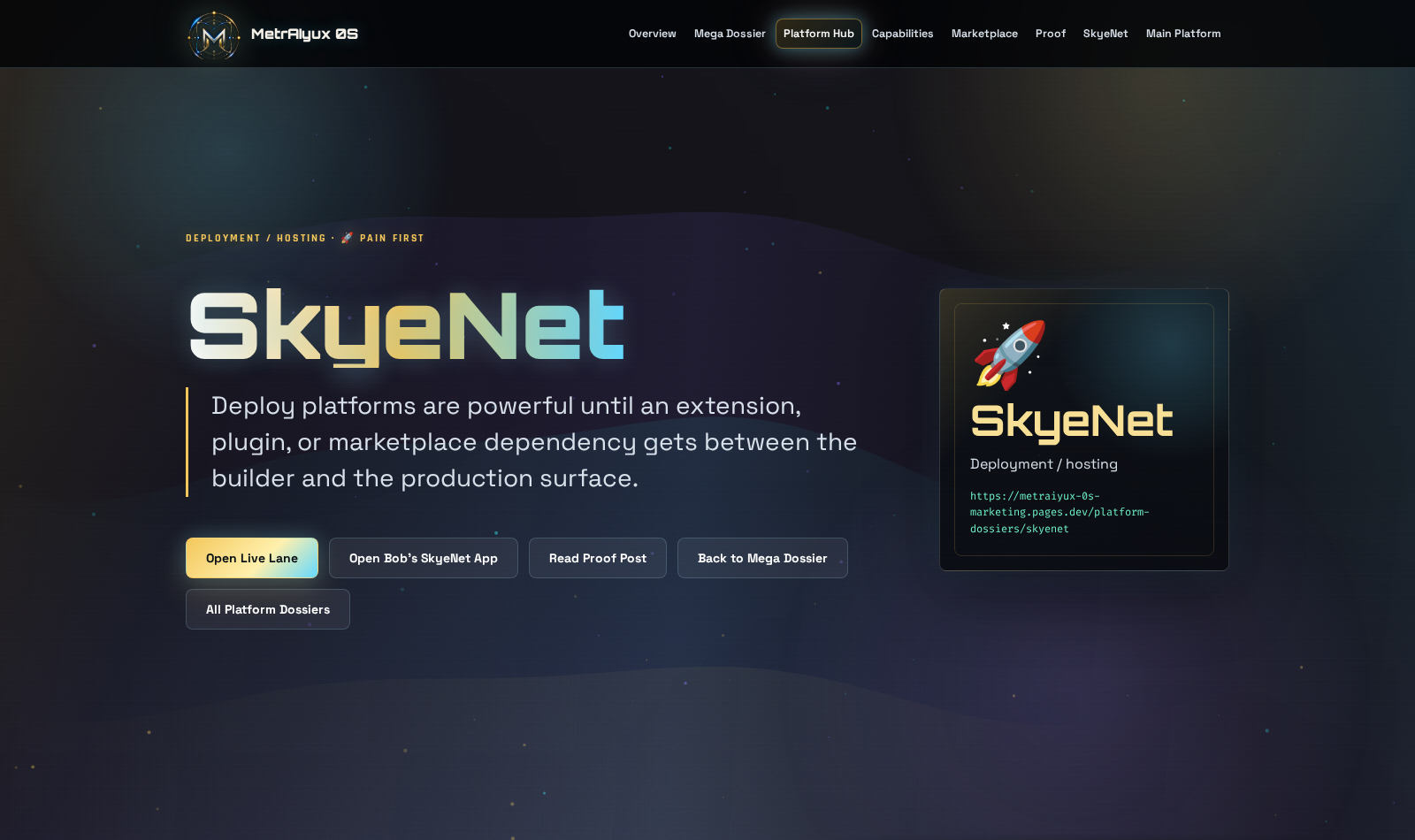
The operator move is to make the article carry the claim.
The move is simple: do not let the workflow be more impressive than the article. If the field note says the system can publish public memory, the field note has to be public memory. If it says proof matters, the proof has to be visible. If it says boundaries matter, the private room has to stay private.
That is the field standard I care about: a page that remembers the machine, respects the reader, and refuses to dress uncertainty up as a finished crown. Anything less is just pretty static trying to borrow credibility from the operating system. Not here.