The field note starts where the public record can embarrass the build.
I do not trust a proof journal because it can summarize a build day. Summaries are cheap. I trust it when the article can name the pressure, pull from the operating system, show what proof exists, keep private material behind the right wall, and still sound like a human founder made a decision in public.
The compact Bookwright test
Write from the machine or do not write about the machine.
A the field note post has to know the difference between listing systems and interpreting them. SkyeMail is not just email. It is identity, inbox trust, workspace motion, SkyePay entitlement, AI review, CRM movement, and the free door into the 0S. SkyeVault is not just storage. It is source custody, restore posture, private package separation, and proof that stops before it leaks the room. Names need relationships.
Darthom Intelligence and the 0S brain give the field note its public memory without dumping the private room. The post can speak with system context, cite the public knowledge surface when it matters, and still keep raw implementation source out of the article.
weak_field_note = topic + summary + receipt_words
founder_field_note = wound + machine_memory + proof_boundary + operator_move
The article has to be the first proof object.
A receipt can prove bytes. It cannot make weak thinking strong. The article itself has to be worth signing: a real thesis, a real visual lane, a reader map, proof language, boundary language, and enough teaching value that a developer or buyer can use it without a private explanation.
Voice is custody.
The founder voice is not seasoning. It is judgment. It decides what is fake, what is useful, what stays private, what proof can be public, and what a serious reader should do next. A field note can be blunt as hell when the bluntness clarifies the failure mode. It just cannot use heat as a substitute for evidence.
The operator move is to make the article carry the claim.
The move is simple: do not let the workflow be more impressive than the article. If the field note says the system can publish public memory, the field note has to be public memory. If it says proof matters, the proof has to be visible. If it says boundaries matter, the private room has to stay private. Anything less is just a pretty page trying to borrow credibility from the machine. Not here.

A field note should feel like the founder walked the reader into the operating room: not a receipt dump, not a changelog, a pressure map with the machine still humming behind it. The image has to carry meaning. ⚡
A build day is not finished when the code compiles. It is finished when the work can be remembered without becoming a brochure.
The public record has to respect the work.
DevodeRator sits in a strange place on purpose. It is not only a company blog, and it is not only a changelog. It is the public field journal around the 0S, SkyeMail, SkyePay, SkyeVault, SkyeNet, Citadel Database, and the operating company behind them. That means the writing has a harder job than normal marketing copy. It has to carry pressure. It has to show the reader what was built, what was proven, what still has a boundary around it, and why the work matters to people who can tell the difference between a real system and a pretty paragraph.
The risk is not just weak prose. Weak prose is easy to spot. The more dangerous failure is a page that sounds confident while quietly exposing the wrong thing: private operator context, unfinished scaffolding, vague claims, or builder-facing material that belongs behind the gate. A public article should feel like the finished surface, not a transcript of how it was assembled. If I am asking serious developers and business owners to read this site, the site has to meet them with finished thinking.
That is the reason for the the field note lane. It turns real build days into public memory. Not content sludge. Not a victory lap. A field note. The difference matters. A field note can be personal and technical at the same time. It can say, "this was hard," then show the route, the receipt, the smoke result, the deployment boundary, or the business consequence. It does not need to reveal keys, raw receipts, private client material, or internal argument to prove that the work happened.
- Public pages carry proof summaries, not private implementation source.
- Claims point toward live surfaces, receipts, route behavior, or clear boundaries.
- Founder voice stays intact without turning the page into an internal work order.
- Visual identity belongs to the shared DevodeRator shell, not one-off article styling.
A real journal cannot have one polished room.
A homepage can make a strong first impression and still betray the brand the second a reader opens an inner page. I have seen that failure too many times in software: one beautiful entry point, then a pile of pages that feel like leftovers. DevodeRator cannot work like that. The proof journal is supposed to be a living surface. The article pages, cards page, social vault, proof routes, and search index all need the same atmosphere, the same hierarchy, and the same sense that somebody is actually operating the system.
The shared visual layer is part of the proof. When a receipt-backed article opens inside a coherent shell, the reader does not have to re-learn the site every time. The page can hold longform writing, linked evidence, source notes, tables, and practical takeaways without feeling like a pasted markdown export. That matters because DevodeRator is trying to earn attention from people who build, buy, audit, or operate systems. They notice when the chrome is lazy.
This is also why the writing lane cannot invent a new design language every time it touches the site. A public journal needs a recognizable room. The the field note can change the argument, the evidence, and the story, but the shell has to keep its identity: dark forge field, strong headings, legible longform rhythm, chapter rails, source racks, media sweeps, and links that look intentional enough for a technical reader to follow.
The the field note turns receipts into a story people can inspect.
Receipts by themselves are not a story. A JSON file can prove a smoke run passed, but it does not explain why the pass mattered. A deployment ID can prove a surface moved, but it does not explain the customer risk that made the move necessary. A route can return 200 and still fail the human who clicks it. The the field note lives in that middle space. It turns evidence into readable context without pretending evidence is the same thing as experience.
That matters especially for the 0S. The system is too large to sell with generic language. SkyeMail is not valuable because a page says "email." It is valuable when inbox state, workspace context, SkyePay plan logic, AI boundaries, CRM movement, and proof receipts agree. SkyeVault is not valuable because a sentence says "secure." It is valuable when source custody, recovery posture, encrypted artifacts, and owner control stay separated correctly. A field note has to help the reader see those distinctions.
The best version of the the field note is honest without being dull. It can say what shipped. It can say what was smoked. It can say what was stress-tested. It can say what is live for manual review. It can also say when a lane is private, capacity-gated, owner-reviewed, or not ready to be sold as unlimited self-serve. That boundary does not weaken the product. It keeps the product credible.
The public surface has to agree with itself.
A public post is not real just because an HTML file exists. The homepage has to know about it. The sitemap has to carry the route. The search index has to return it. The indexing manifest has to describe it. The live URL has to answer after deploy. The old bad routes have to stop pretending they are valid. This is the kind of boring consistency that makes a proof journal useful instead of theatrical.
Readers should not need a private explanation to understand where they are. If a card says a route is a proof article, it should open a proof article. If a social post points to a DevodeRator page, that page should carry the same identity as the rest of the site. If a removed draft is gone, it should be gone from public navigation too. That sounds obvious until automation enters the room. Then it becomes a discipline.
This is why I care about search files, sitemaps, redirects, and 404 behavior. They are not clerical details. They are part of the reader's trust path. A technical buyer who checks links is not being annoying. That buyer is doing exactly what serious people do before they put money or reputation behind a system.
The boundary is part of the product.
The boundary line is where a lot of public technical writing goes wrong. Some teams hide everything and ask the reader to trust vibes. Others dump internal material into public pages and call it transparency. Neither is right. A serious public proof journal can show enough evidence to be inspectable while keeping secrets, raw owner context, private client attribution, bearer tokens, signed URLs, and restricted implementation source out of view.
I want DevodeRator to make that distinction feel normal. A proof article can link to a public surface, summarize a receipt, name the shape of a smoke run, and explain what a route is meant to do. It does not have to expose the private machinery. The public layer should make the product more legible, not more vulnerable.
The editorial shape that keeps the lane useful.
The the field note carries the build memory: founder thesis, real pressure, architecture context, proof lane, boundary lane, and a practical takeaway for a reader who may come back months later.
The the research companion arrives as a second full article. It widens the argument with sources and outside context, then links back to the field note so the pair becomes a living technical conversation.
Reader promise
- The article keeps the founder voice without leaking private operating material.
- The proof language points toward receipts, live routes, or public surfaces.
- The boundary language is direct enough for a technical reader to trust.
- The page belongs visually to DevodeRator instead of feeling pasted in.
The useful version of automation feels less automated.
The irony of a good writing agent is that the reader should not feel trapped inside the machinery. The public article should not say what it was told to do. It should simply be the thing: a clear argument, a useful proof trail, a voice with conviction, and enough restraint to protect what belongs behind the gate. That is the bar I want for DevodeRator.
If the the field note does its job, a reader can follow the build without needing to sit in the repo. A future teammate can see why a decision mattered. A buyer can understand that the system has receipts behind it. A developer can click through the public links and feel that the pages belong to the same world. That is worth building because it turns the 0S from a massive private workspace into a public technical record people can actually learn from.
🧭 Surface proof · Machine-memory lane
Screenshots become evidence when the article knows what they prove.
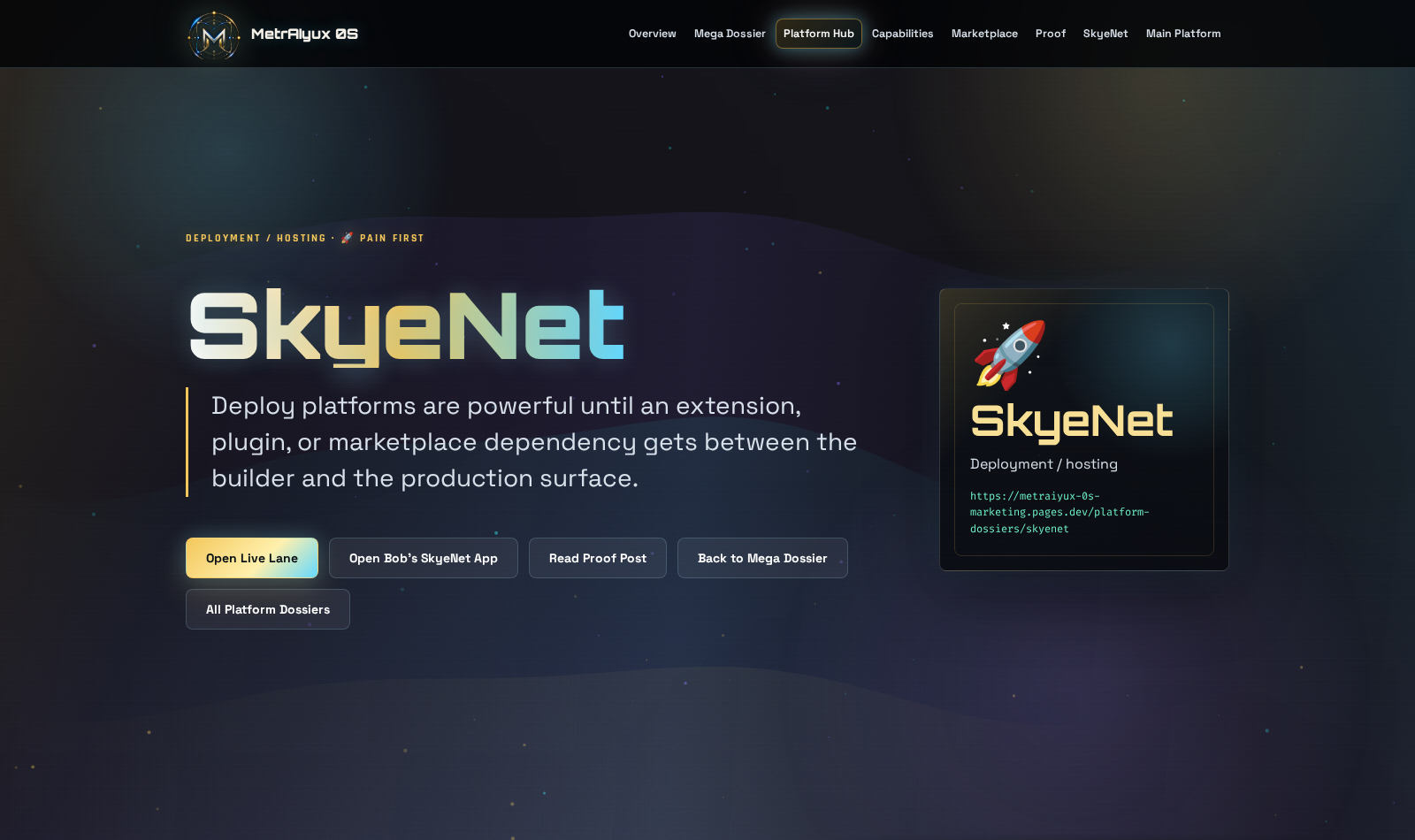
SkyeMail, SkyePay, and SkyeNet are not brand nouns here. They are operating surfaces that show how the field note stays attached to the machine.


The field note has to leave a rule behind.
Related links are useful, but they cannot be the last taste in the reader's mouth. The last taste has to be the rule: a public proof journal earns trust when the article remembers the machine, teaches the reader what changed, shows where the proof starts, and keeps the private room private. That is founder memory in public.
Anything softer is just a clean page asking the 0S to lend it credibility. I want the page to bring credibility back to the 0S. That is the whole point. Make the artifact carry the claim.